

Zero-Downtime Deployment Strategies for Mission-Critical Web Applications
Blue/green cutovers, database schema backward compatibility, and automated health probing to guarantee 99.99% availability without customer disruption.
The Myth of the Maintenance Window
For modern SaaS applications and global enterprises, the traditional 2:00 AM "scheduled maintenance window" is no longer acceptable. With users active across North America, Europe, Africa, and Asia-Pacific, downtime immediately harms customer trust, breaks live webhook integrations, and directly incurs financial penalties under SLA contracts.
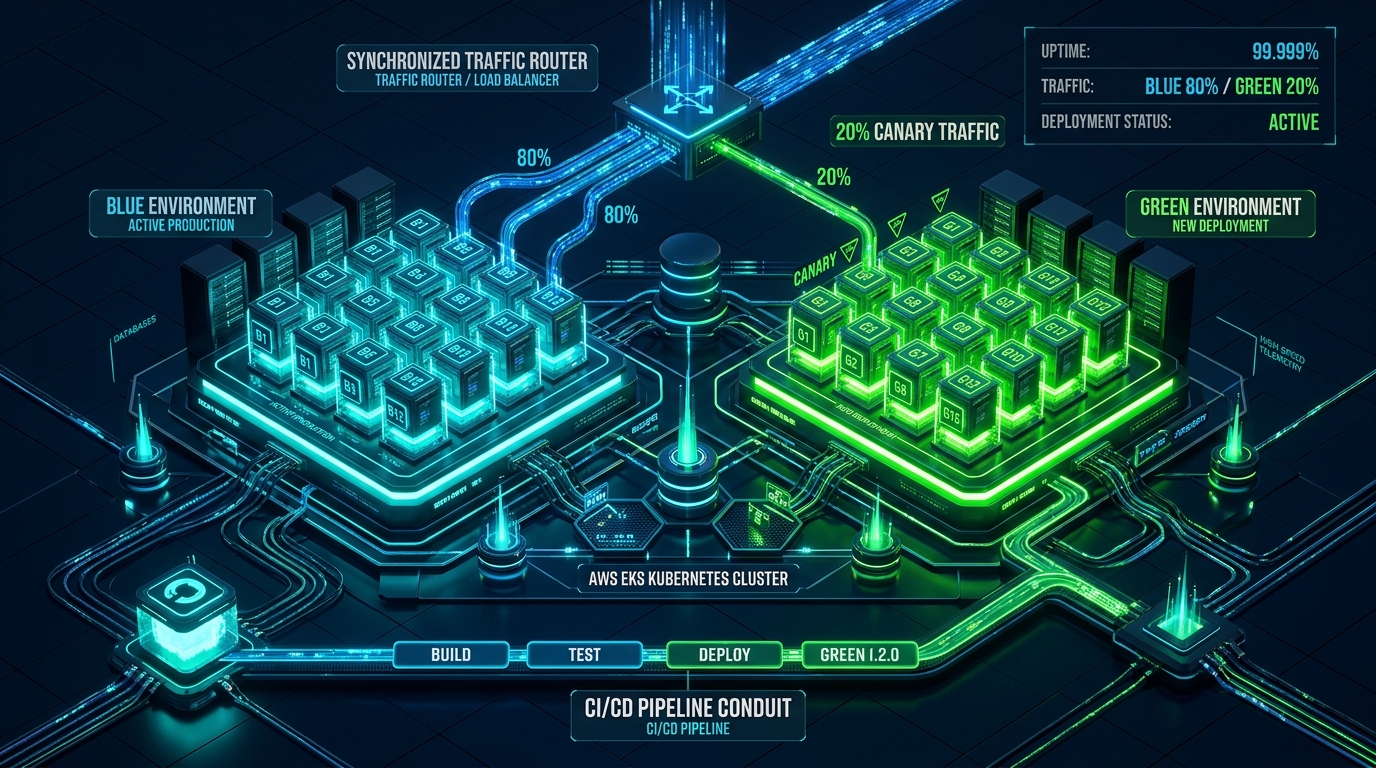
Achieving true zero-downtime deployment requires aligning three distinct architectural layers: 1. Database schema migration backward-compatibility. 2. Blue/Green container cutovers with health-probe gating. 3. Edge connection draining and DNS failover.
---
Step 1: The Expand/Contract Database Migration Pattern
The primary reason deployments cause downtime is breaking database changes—such as renaming or deleting a column while the previous version of application code is still running.
To eliminate this, all schema modifications must follow the Expand / Contract lifecycle:
1. Expand: Add the new column or table without removing the old one. Both columns exist simultaneously. 2. Dual-Write: Deploy application code that reads from the old column but writes to both the old and new columns. 3. Backfill: Run asynchronous background workers to populate the new column for historical rows without locking tables. 4. Contract: Deploy code that exclusively reads and writes the new column. Once verified, safely deprecate and drop the legacy column in a subsequent release.
---
Step 2: Health Probing & Traffic Draining
When new application containers or serverless instances spin up:
- They must not receive live customer traffic until their internal readiness probe returns `HTTP 200 OK` (verifying database connectivity, Redis cache availability, and secret decryption).
- When deprecating old instances, the reverse proxy must send `SIGTERM`, stop directing new requests, and allow existing HTTP connections up to 30 seconds to finish execution gracefully.
---
Architecture Checklist for 99.99% SLA
- Multi-Region DNS with automatic Anycast health failover.
- Point-in-time PostgreSQL backup with automated disaster recovery drills.
- Real-time distributed tracing with P99 latency alerts to catch regressions before end users notice.